
The Counterweight | How Gratitude Can Help an Anxious Mind
What if the answer to an anxious mind isn't found in controlling your thoughts, but in learning where to direct them?
It usually happens in the quiet moments. You're sitting at the kitchen table, a lukewarm cup of coffee between your hands, when anxiety settles into your chest. Before you know it, your mind is racing ahead, mapping out worst-case scenarios and trying to prepare for every possible outcome.
Someone might tell you to focus on what you're grateful for. And while the advice is well-intentioned, it can feel almost impossible when your heart is racing and your thoughts won't slow down. Listing your blessings doesn't automatically make the worry disappear. Sometimes, when it doesn't, you feel guilty for being anxious in the first place.
Gratitude was never meant to be a cheerful mask we wear to hide what hurts. It is a way of remembering what is still true and good, even when life feels uncertain. And science is beginning to help us understand why that practice matters.
Research has found that intentionally practicing gratitude can support emotional well-being and may help reduce symptoms of anxiety. It doesn't eliminate difficult emotions, but it can help us shift our attention away from everything we fear and make room for what is good and meaningful.
This is not a new idea. Scripture has been pointing us toward this kind of intentional thinking for centuries.
In Philippians 4:6-7, Paul writes:
"Do not be anxious about anything, but in every situation, by prayer and petition, with thanksgiving, present your requests to God." (NIV)
Notice that Paul doesn't tell us to pretend we have nothing to worry about. He tells us where to take our worries. And he makes a point of including thanksgiving.
Changing What Gets Our Attention
When we feel threatened or overwhelmed, our brains naturally begin looking for danger. The systems involved in detecting threats help prepare us to respond, but they can also keep our attention fixed on what might go wrong. We replay conversations, anticipate problems, and search for ways to regain control.
When worry becomes persistent, it can be difficult to see beyond the thing that frightens us.
Gratitude gives our attention somewhere else to go. Instead of concentrating only on what is missing, uncertain, or frightening, we deliberately notice what is still good. Research has associated gratitude practices with changes in brain activity related to emotional processing and reward. While scientists are still studying exactly how these changes work, the evidence suggests that gratitude can be a helpful part of caring for our emotional well-being.
It doesn't switch off anxiety. It doesn't mean we can never feel grateful and anxious at the same time. But it can help keep fear from becoming the only thing we see.
That is part of what makes Paul's instruction so practical. He invites us to bring our concerns to God, but not to bring them alone. We bring them with thanksgiving, remembering His goodness even as we ask Him for help.
Psalm 23 gives us another picture of this kind of perspective. David writes, "You anoint my head with oil; my cup overflows" (Psalm 23:5, NIV). He doesn't describe a life without trouble. Just a few verses earlier, he speaks of walking through the darkest valley. Yet even there, he recognizes the goodness and presence of his Shepherd.
We can become so focused on the valley that we forget to look at what is still in our cup. Anxiety draws our attention toward what might be missing, what could go wrong, and what we cannot control. Gratitude reminds us to notice God's provision, His mercy, the people He has placed beside us, and the ways He has carried us before.
There is more to our story than the thing we are afraid of.
When You're Living in the Pause
Sometimes the hardest place to practice gratitude is the space between what God has promised and what we can actually see.
You have prayed. You have believed. You are waiting for an answer, a breakthrough, or a change in circumstances. But the situation hasn't moved yet. And in that waiting, your mind begins filling in the blanks. What if it doesn't happen? What if things get worse? What if the answer never comes?
It is easy to let fear occupy that space.
But God's goodness is not dependent on how quickly our circumstances change. Psalm 23:6 says, "Surely your goodness and love will follow me all the days of my life" (NIV). David's confidence wasn't based on having every detail figured out. It came from knowing the Shepherd who was leading him.
This is where gratitude becomes more than remembering the good things that have happened. It becomes a way of trusting God with what has not happened yet.
Paul takes this a step further in Philippians 4:8, encouraging believers to think about whatever is true, noble, right, pure, lovely, admirable, excellent, or praiseworthy.
This is more than positive thinking. It is an invitation to be intentional about what we allow to occupy our minds. We may not be able to stop every anxious thought from coming, but we can choose not to spend the entire day rehearsing it. We can turn our attention toward what is true about God, what He has promised, and how faithfully He has carried us before.
You aren't ignoring the storm. You are remembering that you have shelter.
Gratitude Doesn't Require a Perfect Day
Perhaps the most important thing to understand is that gratitude and anxiety can exist at the same time. You don't have to feel completely peaceful before you can give thanks. And you don't have to pretend a painful situation is good to recognize God's goodness.
You can be worried about tomorrow and thankful for God's presence today. You can be grieving a loss and grateful for the people who are holding you up. You can feel overwhelmed and still trust that you are not carrying the burden alone.
This is not toxic positivity. It is honest faith.
When Jesus fed the five thousand, the disciples saw a problem: thousands of hungry people and nowhere near enough food. There were only five loaves and two fish. But Jesus took what was available, gave thanks, and multiplied it (John 6:7-13). What looked insufficient in the hands of the disciples became more than enough in the hands of Jesus.
That story reminds us that gratitude doesn't require us to have everything we need in front of us. It begins with recognizing what God has placed in our hands and trusting Him with what we cannot supply ourselves.
Paul didn't promise that every problem would immediately disappear. He promised that as we bring our requests to God, His peace can guard our hearts and minds in Christ Jesus. That peace doesn't depend on having every answer. It comes from knowing the One to whom we have brought our concerns.
Where Will You Direct Your Attention?
The next time worry begins to take over your thoughts, pause and ask yourself: What is one truth about God or one evidence of His faithfulness I can bring back into focus?
It may be a prayer He answered, a person who showed up when you needed them, a provision you didn't see coming, or simply the reminder that His mercy is new every morning. Name it. Thank Him for it. Then bring Him the thing that is still troubling you.
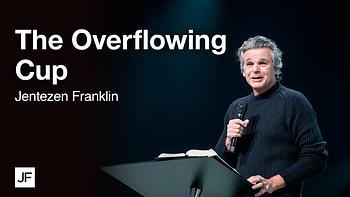
If you would like to hear more about the picture of God's overflowing goodness, watch the broadcast message The Overflowing Cup. It offers a powerful reminder to look beyond what we lack and recognize the goodness and mercy of God.
There will always be things we cannot control, questions we cannot answer, and circumstances we cannot change. But we can bring all of them to a God who cares for us. We can remember His goodness in the middle of uncertainty and choose to give our attention to what is true.
You may not know what tomorrow holds, but you can be held by the One who holds tomorrow.
Share